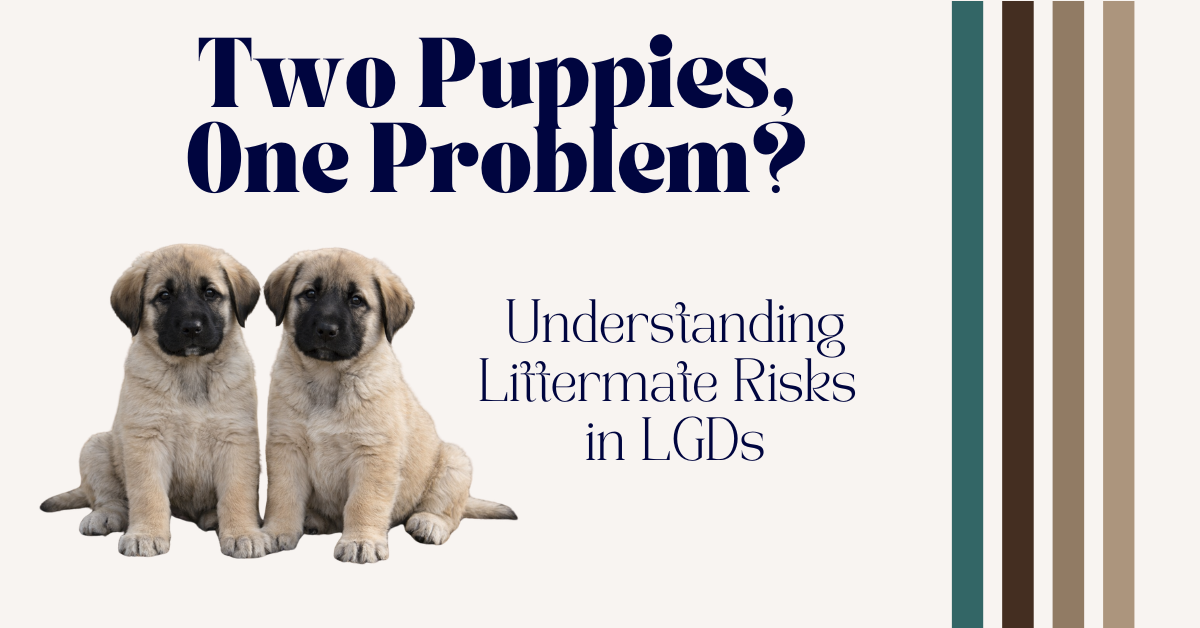
I get asked all the time: “Can I take two pups from the same litter?” I always answer no, and I want to explain exactly why. With livestock guardian dogs, your success in the field depends on so many things—temperament, bonding, confidence, and independence. When two pups come home together, you put all of that at risk, often without even realizing it until things have already gone off the rails.
What is “Littermate Syndrome”?
“Littermate syndrome” is a catch-all name for a cluster of behavior problems often seen when two puppies of the same age are raised in the same home, especially when they only have each other to lean on. The science on this exact thing is pretty thin, and behavior consultants debate whether it is one true syndrome or a bundle of related issues. But there is a well-documented pattern of behaviors that crop up in pairs raised together that are problematic, and especially problematic for working livestock guardian dogs.
These behaviors include:
- Hyper-bonding to each other, not to you or the stock
- Poor independent social confidence
- Separation anxiety
- Distractibility from training
- Increased risk of aggression or rivalry over resources
- Delayed maturation and co-dependence
It’s not just about them sharing genetics. Puppies of any two dogs, related or unrelated, taken home at the same time and allowed to lean on each other, can show the same issues.
Why This Is Especially a Problem with Livestock Guardian Dogs
Livestock guardian dogs are bred to bond with the stock they protect and to function independently. In a working setup, your dog is expected to engage livestock, deter predators, and respond reliably to you. If those two puppies spend their formative weeks and months focused on each other, they don’t develop the right bond or the right confidence. Some common outcomes I see:
- Puppies that won’t focus on stock because their best friend is right beside them
- Dogs that panic if separated for a training session or job task
- Training that feels like pulling teeth because the pups keep each other occupied
- A “teenage phase” that drags out far longer than normal because they haven’t matured emotionally
Worst-case scenarios aren’t rare: fights over resources or hierarchy that escalate into serious injury or worse, dogs whose only stable relationship is with their sibling and not with the stock or their handler.
It Isn’t Just “They Love Each Other Too Much”
I’ve read posts (and heard comments) that dismiss this as a myth, or say littermates can work just fine. In a few rare cases, that might happen. But livestock guardian dogs are not couch pets; they are independent, working animals. The stakes are higher on a farm than in a living room. Some critics even argue that littermate syndrome doesn’t scientifically exist, and that the behaviors come down to owners not training or socializing enough.
Here’s the thing, though: even the debunkers agree that behaviors attributed to littermate syndrome do show up regularly—it’s just less about genetics and more about how the dogs are raised and bonded. When two pups grow up swirling around each other like twin tornadoes, they often don’t get the individual development they need.
That’s exactly why I have made a policy not to sell littermates together.
Why I Only Place One Puppy at a Time
In my program:
- Each puppy goes to a home on its own
- That dog can bond with you, your farm, and your livestock first
- Future dogs, if any, are brought in much later, so the first dog matures and sets the tone
This approach means you get a well-rounded, confident, bonded guardian that knows its place in your operation. It means better socialization, better training focus, and better working instincts. It means fewer late-night crises, breaking up fights, or chasing down two dogs that think their sibling is more important than the herd.
Final Thought
Two working guardian dogs can absolutely succeed together—but not if they start life hand-in-paw. Independence, confidence, and focus are what make a great livestock protection dog, not social dependency. If a second dog is in your future, let the first be fully formed and anchored to its role before you bring in another.
That’s the safe, smart way to build a reliable team your livestock can count on.
